 Call
Call Here When You Need Us
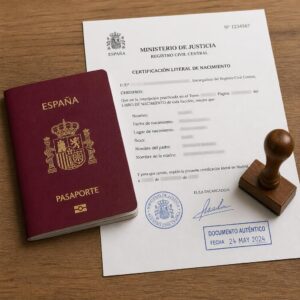
How to Authenticate Spanish Documents for Use Abroad
Apostilles, Embassy Legalisation and International Requirements Explained
Whether you need to register a death, settle an estate, transfer property, deal with probate or present official Spanish documents overseas, understanding the correct authentication process can save weeks of delays and unnecessary expense.
This guide explains when you need an Apostille, when Embassy Legalisation is required, how long each process typically takes, and the most common mistakes that delay international document acceptance.
At a Glance
| Best for | Anyone needing official Spanish documents recognised outside Spain. |
| Typical Time | Apostille: Around 1 week. Embassy Legalisation: 4–10 weeks (sometimes longer depending on the country). |
| Most Common Documents | Death Certificates, Cremation Certificates, Probate Documents, Court Documents, Birth & Marriage Certificates, Powers of Attorney. |
| Most Important Step | Confirm the destination country’s requirements before beginning the process. |
| Can Funecon Help? | Yes. We can coordinate document collection, certified translations, Apostilles and Embassy Legalisation from Spain. |
Quick Decision Guide
Which authentication process do you usually need?
If your documents will remain in Spain
➡️ No international authentication is normally required.
If your documents will be used outside Spain
Ask one question:
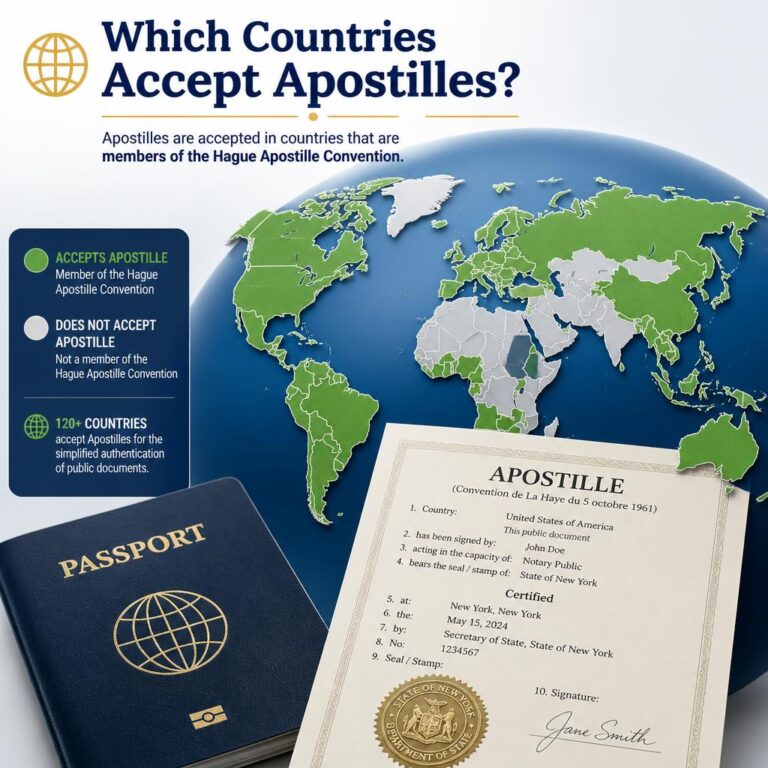
Is the destination country a member of the Hague Apostille Convention?
Yes
Your documents will normally require an Apostille.
Typical timeframe:
Around one week.
No
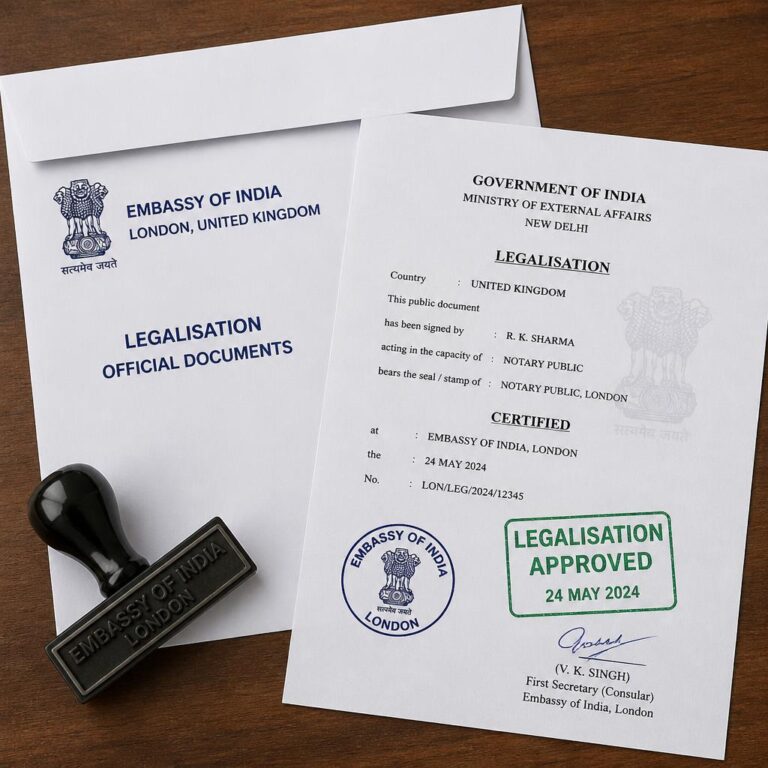
Your documents will normally require Embassy Legalisation.
Typical timeframe:
Four to ten weeks, and occasionally longer depending on embassy requirements.
Not sure which process applies?
Our country guide below (and future country lookup tool) can help you identify the correct authentication process before you begin.
Why Authentication Is Needed
Spanish public documents are legally valid in Spain.
However, another country usually needs official confirmation that those documents are genuine before accepting them for legal or administrative purposes.
This process is known as document authentication.
Depending on the destination country, authentication is achieved through either:
- an Apostille, or
- Embassy Legalisation.
Think of authentication as creating official trust between two countries.
The objective is always the same:
To ensure your Spanish documents are recognised and accepted in the country where they will be used.
Apostille vs Embassy Legalisation
Although both authenticate documents, they are designed for different international systems.
Apostille
An Apostille is an internationally recognised certificate attached to an official document.
Countries that are members of the Hague Apostille Convention accept Apostilled documents without requiring further embassy legalisation.
For many families this makes the process considerably faster and simpler.
Embassy Legalisation
Some countries are not members of the Hague Apostille Convention.
These countries require additional verification before accepting foreign documents.
Depending on the country, this may involve:
- authentication by the appropriate Spanish authorities,
- official sworn translations,
- legalisation through the destination country’s embassy or consulate,
- authentication of translated documents,
- additional country-specific requirements.
Although more involved, this ensures the receiving country’s authorities recognise the documentation as valid.
Typical Timeframes
One of the first questions families ask is:
“How long will this take?”
The answer depends almost entirely on the destination country.
| Process | Typical Time |
|---|---|
| Apostille | Around 1 week |
| Embassy Legalisation | Typically 4–10 weeks |
Please remember these are typical timeframes.
Processing times may vary depending on:
- embassy processing times,
- official translation requirements,
- public holidays,
- document type,
- additional country-specific requirements.
Where deadlines are important, we always recommend starting the authentication process as early as possible.
Country Requirements
Different countries have different authentication requirements.
For example:
| Destination Country | Typical Authentication |
|---|---|
| United Kingdom | Apostille |
| Ireland | Apostille |
| Australia | Apostille |
| France | Apostille |
| Germany | Apostille |
| Malaysia | Embassy Legalisation |
| United Arab Emirates | Embassy Legalisation |
| Qatar | Embassy Legalisation |
| China | Embassy Legalisation (subject to current bilateral arrangements) |
We’ll expand this into a complete searchable country directory, allowing visitors to quickly confirm the requirements for their destination country.
Documents That Commonly Require Authentication
The documents we most frequently help families prepare include:
- Death Certificates
- Multilingual Death Certificates
- Cremation Certificates
- Court Documentation
- Autopsy Reports
- Probate Documents
- Birth Certificates
- Marriage Certificates
- Notarial Documents
- Powers of Attorney
The exact documents required will depend on both the destination country and the purpose for which they are being used.
Before You Start
Before requesting authentication, we recommend confirming:
✅ What country will receive the documents.
✅ Does that country accepts Apostilles.
✅ Are certified translations are required.
✅ Do the translations themselves also require authentication – this is rare but worth asking upfront.
✅ Whether you have enough time before any legal or administrative deadlines.
Spending a few minutes confirming these points at the outset can prevent weeks of unnecessary delays later.
Case Study – United Kingdom
A recent family required Spanish documentation to be recognised in the United Kingdom.
As the UK accepts Apostilles under the Hague Apostille Convention, the process was relatively straightforward.
The documentation was authenticated through an Apostille and accepted without the need for embassy legalisation, allowing the family to continue with the administration of the estate quickly.
Case Study – Malaysia
Another family required Spanish documentation to be recognised in Malaysia.
Unlike Apostille countries, this process required embassy legalisation.
In addition, the official translations also required legalisation before the documents could be accepted.
This additional step is often overlooked and can significantly extend the overall timeframe if not identified early.
This case demonstrates why every country should be treated individually rather than assuming the same process applies worldwide.
Common Mistakes That Cause Delays
Some of the most common reasons for delays include:
- Assuming every country accepts Apostilles.
- Requesting the wrong version of a document.
- Using unofficial translations.
- Legalising documents in the wrong order.
- Not checking whether translated documents also require authentication.
- Waiting until just before an important legal deadline.
Most of these delays can be avoided by confirming the destination country’s requirements before starting.
How Funecon Can Help
We regularly assist international families with preparing Spanish documents for use around the world.
Our service can include:
- Obtaining official Spanish documents.
- Arranging certified translations.
- Apostille services.
- Embassy legalisation.
- Liaising with Spanish authorities.
- Coordinating international documentation.
- Keeping families informed throughout the process.
Whether the documents are needed following a bereavement, for probate, inheritance, property matters or other legal requirements, our aim is to make the process as straightforward and transparent as possible.
Related Guides
Understanding the Process
Death Documentation
- Understanding Death Certificates, Cremation Certificates and Autopsy Paperwork in Spain
- How to Read a Spanish Death Certificate
- How to Request an Autopsy Report in Spain
Need Practical Help?
Explore More
Looking for something else? Browse our complete collection of practical guides covering funeral planning, cremation, repatriation, legal documentation and post-death administration in Spain.
Have questions? Want us to visit your area for a Coffee Morning?
We’re here to help. Leave your details below if you’d like a no-obligation call, or if you’d like us to arrange a Coffee Morning in your town. Our goal is to bring clarity, peace of mind, and honest information to the expat community in Spain.