 Call
Call Here When You Need Us
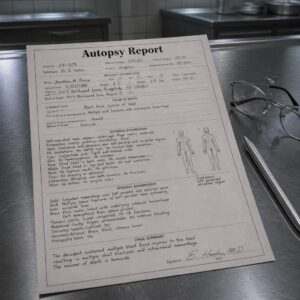
How to Request an Autopsy Report in Spain
Step-by-Step Guidance for Families
When a death in Spain involves a judicial investigation or forensic examination, families are often unsure how to obtain the autopsy report or which authority is responsible for it.
For many international families, this process can feel unclear — especially when trying to navigate the Spanish court system from abroad during a difficult time.
This guide explains the practical steps families usually follow to request a preliminary or final autopsy report in Spain, including:
- how to identify the correct court,
- what documents are normally required,
- and what information to include in the request.
Who Holds the Autopsy Report in Spain?
In Spain, autopsy reports are usually handled by the investigating court responsible for the case — typically the local Juzgado de Instrucción (Investigating Court).
This commonly applies where the death involves:
- a sudden or unexpected death,
- an accident,
- an unattended death,
- or circumstances requiring judicial investigation.
In these situations, the report is often managed through the court system rather than directly through the hospital or funeral home.
If you would like to understand more about judicial investigations and autopsies in Spain, you can read our related guide here:
When the Court Gets Involved: Autopsy and Judicial Death Investigations in Spain
How to Find the Correct Court
The most important step is identifying which court is handling the case.
In many cases, the court information can be found on:
- the death certificate,
- judicial or police documentation,
- hospital paperwork,
- or communications received after the death.
You are usually looking for the local Juzgado de Instrucción connected to the area where the death occurred.
If you are unsure which court is responsible, Spain’s national judicial directory can help:
You can normally search by:
- province,
- city,
- or court type.
Documents You Normally Need
When requesting an autopsy report, families will usually need to provide:
- Copy of passport or ID
- Death certificate
- Proof of relationship to the deceased where possible
- Full name of the deceased
- Date and place of death
- Email address for correspondence
For international families, proof of relationship is often established through shared surnames, passports, birth certificates, or other supporting documentation.
If you still need to obtain the death certificate, our guides below may help:
Spanish Death Certificate Guide for International Families
What to Request
When contacting the court, families will often request:
- The preliminary autopsy report (if available)
- The final or complete autopsy report once finished
- Delivery by email where possible
It is generally helpful to clearly include:
- your relationship to the deceased,
- your contact details,
- and the documents attached to support the request.
Example Email Template
Below is a simple example families can adapt when contacting the court handling the case.Solicitud de informe de autopsia
Solicitud de informe de autopsia
A la atención del Juzgado de Instrucción correspondiente
Buenos días,
Mi nombre es [NOMBRE COMPLETO] y me dirijo respetuosamente a este Juzgado en relación con [NOMBRE DEL FALLECIDO], fallecido/a el día [FECHA] en [CIUDAD], España.
En mi condición de [RELACIÓN FAMILIAR], solicito amablemente:
- Copia del informe preliminar de la autopsia, si estuviera disponible.
- Que, una vez finalizado, el informe definitivo y completo de la autopsia me sea remitido por correo electrónico.
Mi dirección de correo electrónico es:
[EMAIL]
Adjunto a esta solicitud la documentación acreditativa correspondiente:
• Copia de mi pasaporte o documento de identidad
• Certificado de defunción
• Documentación acreditativa de mi relación con el fallecido/a
Quedo a disposición de este Juzgado para aportar cualquier información adicional que pudiera ser necesaria.
Muchas gracias por su atención.
Atentamente,
[NOMBRE]
How Long Does an Autopsy Report Take in Spain?
Timeframes can vary significantly depending on the circumstances of the death and the court handling the case.
In many situations:
- a preliminary report may become available within days or weeks,
- while the final forensic report can take considerably longer 2-6 months in many cases.
Judicial and forensic delays are not uncommon in Spain, particularly where toxicology or additional investigations are involved.
It is also common for families to need to follow up with the court if no response is received initially.
Common Difficulties Families Face
Some of the most common issues include:
- uncertainty about which court is handling the case,
- language barriers,
- delays in the final report being completed,
- or difficulty understanding which documents are required.
For families living outside Spain, these processes can feel especially complicated during an already stressful time.
Need Help Understanding the Process?
At Funecon, we regularly help international families navigate practical and administrative processes after a death in Spain.
While we cannot provide legal advice, we may be able to help you understand:
- which court may be handling the case,
- what documents are usually required,
- and how families typically communicate with the relevant authorities.
You may also find these related guides helpful:
When the Court Gets Involved: Autopsy and Judicial Death Investigations in Spain
Flying Ashes Home from Spain: Airline Rules & Guidance
Have questions? Want us to visit your area for a Coffee Morning?
We’re here to help. Leave your details below if you’d like a no-obligation call, or if you’d like us to arrange a Coffee Morning in your town. Our goal is to bring clarity, peace of mind, and honest information to the expat community in Spain.