 Call
Call Here When You Need Us


Funeral Costs in Spain: A Complete Guide
A funeral in Spain can cost anywhere from around €1,400 for a simple direct cremation to €6,000 or more for a traditional funeral, burial or international repatriation.
But there isn’t one standard price for a funeral in Spain.
The final cost depends on where the person has died, whether the family chooses cremation or burial, the funeral facilities used and — importantly — the services the family actually wants.
If you’ve received very different prices from different funeral companies, that doesn’t necessarily mean one is expensive and another is cheap. They may be quoting for completely different funerals.
This guide will help you understand what funerals typically cost in Spain, why prices vary, what is normally included and which services you can choose.
Funeral costs in Spain at a glance
The following ranges provide a useful starting point:
| Type of funeral or service | Typical cost in Spain |
|---|---|
| Direct cremation | €1,400–€2,250 |
| Cremation with additional funeral services | €2,000–€4,500+ |
| Simple burial, excluding purchase of niche or plot | €1,200–€2,000+ |
| Burial including cemetery costs and additional funeral services | €3,000–€6,000+ |
| International repatriation | Often €3,000–€6,500+ |
These are indicative ranges rather than fixed national prices.
Location, transport, facilities, cemetery or crematorium charges and the services chosen by the family can all affect the final cost.
The most important thing to understand
When comparing funeral prices, don’t compare the total price until you understand what is included.
A €1,800 cremation and a €4,000 cremation may both be fairly priced.
The first might cover collection, documentation, coffin, cremation and return of the ashes.
The second might also include a velatorio, preparation of the deceased for viewing, flowers, a hearse and a religious ceremony.
Both involve cremation.
They are not the same funeral.
How much does cremation cost in Spain?
A simple direct cremation in Spain will typically cost approximately €1,400–€2,250, depending on location and provider.
Direct cremation normally means there is no traditional viewing or funeral ceremony before the cremation.
The service will generally involve the essential arrangements required to collect the deceased, complete the necessary administration, provide a suitable coffin, carry out the cremation and return the ashes in an urn.
But direct cremation is only one form of cremation.
Families can also choose to add:
- A church service
- A chapel ceremony
- A religious blessing
- A civil ceremony
- A private family farewell
- A traditional velatorio
- Flowers
- Other personal elements
This means cremation does not have to mean having no funeral or opportunity to say goodbye.
There is a considerable middle ground between direct cremation and a full traditional funeral package.
Our Burial & Cremation Costs in Spain guide explains these different options and typical costs in more detail.
How much does burial cost in Spain?
Burial costs are more difficult to generalise because cemetery costs vary significantly.
A relatively simple funeral excluding the purchase or concession of a burial space may begin at around €1,200–€2,000.
Once cemetery charges, a niche or grave, funeral facilities, viewing, ceremony and other services are included, a burial can commonly cost €3,000–€6,000 or more.
One important difference for international families is the Spanish cemetery system.
In many parts of Spain, burial takes place in a wall niche known as a nicho. Families may acquire the right to use the niche for a specified period rather than purchasing a grave permanently.
The cost and rules vary between municipalities.
If your family is considering burial, establish early whether a burial space already exists and what cemetery charges apply.
How much does repatriation from Spain cost?
Returning someone who has died in Spain to another country is a very different service from arranging a local funeral.
Full-body repatriation may involve:
- Collection and care of the deceased
- Specialist preparation
- A suitable international transport coffin
- Documentation
- Consular requirements
- Transport within Spain
- Air or road transport
- Coordination with the receiving country
As a broad indication, international repatriation from Spain may cost approximately €3,000–€6,500 or more, although destination and transport arrangements can move the price outside this range.
Air repatriation costs in particular depend partly on flight routing and cargo availability.
Families should also consider whether the deceased had travel insurance or another policy that may cover repatriation.
Our Repatriation from Spain Guide explains the process, timescales and costs in greater detail.
Why do funeral costs vary so much in Spain?
There are two main reasons.
Where in Spain the funeral takes place
There is no single national funeral tariff.
Costs can vary according to:
- Province
- Municipality
- Funeral-home facilities
- Crematorium used
- Cemetery
- Distance and transport
- Availability of local services
- Local operating costs
A funeral in Alicante does not necessarily cost the same as an equivalent funeral in Madrid, Barcelona, Málaga or one of the islands.
What the funeral actually includes
This is often the more important explanation.
A traditional funeral package may include services such as:
- Velatorio
- Preparation of the deceased
- Open-casket viewing
- Flowers
- Hearse
- Chapel
- Religious or civil ceremony
- Additional transport
- Upgraded coffin
Another family may want none of those things.
That can create differences of thousands of euros between two funeral quotations without necessarily meaning that either quotation is unreasonable.
What is a velatorio and how does it affect the cost?
A velatorio is a traditional period of gathering and viewing before the funeral or cremation.
It normally takes place in a tanatorio or funeral home and may provide a private room for family and friends for an extended period, often around 24 hours.
For many Spanish families, this is an important part of the funeral.
International families may be less familiar with the tradition.
The cost can involve more than simply hiring the room.
Where there will be an open-casket viewing, the deceased normally needs to be appropriately prepared and presented. Other services may also form part of the arrangement.
For a family that wants a traditional viewing, these services may be extremely important.
But a velatorio isn’t the only way to have a funeral.
Can we have a funeral service without a velatorio?
Yes.
This is an option international families don’t always realise exists.
Depending on local facilities, you may be able to arrange:
- A church service
- A funeral-home chapel
- A crematorium chapel
- A religious blessing
- A civil ceremony
- A private family farewell
- A closed-casket service
A closed coffin may also reduce the preparation required compared with an open-casket viewing.
This can allow families to have a meaningful ceremony without arranging every element of a traditional funeral package.
Our Understanding Funeral Packages in Spain guide explains the different components of a funeral and the choices families can make.
Do we have to buy a funeral package?
Not necessarily.
Traditional funeral packages can be very convenient and may be exactly what your family wants.
But it is worth understanding what is included before agreeing to one.
Ask yourself:
Do we want a viewing?
Do we want a velatorio?
Would we prefer a church or chapel service?
Do we want flowers?
Would we rather hold a memorial later?
There isn’t one correct combination.
At Funecon, we start with what the family wants and build the service around those choices rather than assuming every family wants the same package.
If you want direct cremation, we can arrange direct cremation.
If you want cremation and a church service, we can explore that.
If you want a traditional viewing and funeral, those services can also be arranged.
The family decides what is meaningful.
What funeral costs can families sometimes overlook?
The most important protection against unexpected costs is a clear written quotation.
Depending on the funeral, check whether the price includes:
- IVA (VAT)
- Collection of the deceased
- Transport
- Coffin
- Cremation
- Cemetery fees
- Niche or burial rights
- Velatorio
- Preparation for viewing
- Flowers
- Chapel
- Religious or civil ceremony
- Urn
- Documentation
- Additional certificates
- Delivery or collection of ashes
- International documentation where applicable
Not every funeral requires every one of these services.
The point is to understand which ones apply to yours.
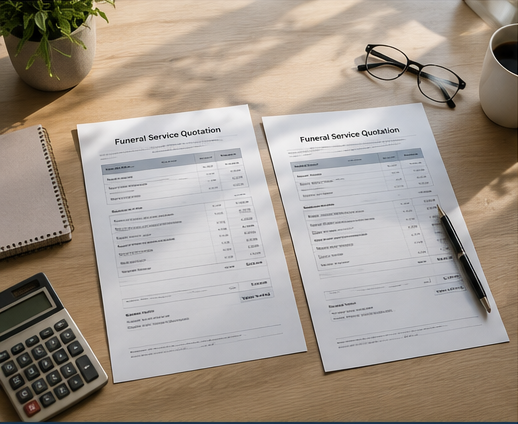
How should I compare funeral quotes?
Compare like-for-like.
Don’t simply put two total prices beside each other.
First establish:
- What type of funeral is being quoted?
- What services are included?
- What services are optional?
- Is IVA included?
- Are there costs that haven’t yet been confirmed?
- What circumstances could cause the price to increase?
The lowest quotation isn’t automatically the best value.
Equally, a more expensive funeral isn’t necessarily better if it contains services your family doesn’t want.
Our How to Compare Funeral Quotes in Spain guide provides a practical checklist you can use when reviewing quotations.
Who pays for a funeral in Spain?
The person arranging a funeral is not necessarily the person who ultimately bears the expense.
In practice, a relative or another person may make the immediate payment so the funeral can proceed.
Funeral and burial expenses can then be relevant when the deceased’s estate is administered, and justified funeral and burial expenses may be deductible when calculating the taxable inheritance subject to the applicable requirements.
There may also be:
- Funeral insurance
- A prepaid funeral plan
- Travel insurance
- Other relevant insurance
The practical problem is often timing.
Funerals need to happen quickly.
Estates, insurers and banks can take considerably longer.
Our Who Pays for a Funeral in Spain? guide explains the difference between arranging, paying and ultimately accounting for funeral expenses.
How do international families pay for funerals in Spain?
You don’t necessarily need to travel to Spain simply to make payment.
Depending on the funeral provider, payment may be possible through:
- Bank transfer
- Debit or credit card
- Secure digital payment
Bank transfers are commonly used, particularly for larger amounts, but families should allow for banking and international-transfer delays.
If the deceased’s Spanish bank account is expected to fund the funeral, contact the bank early. Banks may have their own documentation and internal approval procedures before funds can be released.
At Funecon, families can currently pay securely by digital card payment or bank transfer.
What if I don’t know what type of funeral we want?
That’s completely normal.
You don’t need to decide between every possible option before speaking with a funeral provider.
Start with what you know.
For example:
- We want cremation.
- We want the family to be able to say goodbye.
- We don’t want an open coffin.
- We would like a Catholic service.
- We want the ashes returned to Ireland.
- We want something simple.
- We don’t know what we want yet.
Those are enough to begin a conversation.
A good funeral provider should be able to explain the options available locally and help you understand how each choice affects the arrangements and cost.
What if someone has just died?
If the death has already occurred, the immediate priority is usually establishing:
- Where the deceased is located
- Who can authorise the funeral
- Whether cremation, burial or repatriation is being considered
- Whether insurance may be involved
- What the family’s immediate wishes are
You do not need to understand the entire Spanish funeral system before asking for help.
Planning ahead
If you’re researching funeral costs because you or a family member lives in Spain and wants to plan ahead, doing this research now can be extremely useful.
Understanding likely costs allows you to:
- Discuss wishes with family
- Decide between cremation and burial
- Consider whether a ceremony is important
- Review funeral insurance or prepaid arrangements
- Prepare the information your family may later need
- Set aside appropriate funds
Planning ahead doesn’t require you to purchase a funeral immediately.
Sometimes simply documenting what you want can remove a considerable burden from your family later.
The most important thing to remember
A funeral price only makes sense when you understand what you’re buying.
Don’t assume the most expensive funeral is the best.
Don’t assume the least expensive funeral is the right choice either.
Understand the services.
Decide what matters to your family.
Then compare the cost of providing that funeral.
Still unsure what is right for your family?
Every family’s circumstances are different.
If you’re trying to understand funeral costs in Spain, compare options or work out what type of farewell would be appropriate, you can talk it through with us.
You don’t need to know exactly what you want.
And you don’t need to have decided to use Funecon before speaking with us.
Tell us what has happened, where the person is located and what your family is considering. We’ll explain the available options and help you understand the likely costs.
Talk to Funecon by WhatsApp or phone.
🟢 Scan to message us instantly on WhatsApp

Explore our funeral guides
If you need more detail on a particular subject:
- Understanding Funeral Packages in Spain — learn what is included in traditional packages and which services can be chosen separately.
- Burial & Cremation Costs in Spain — compare typical costs and the different funeral options available.
- How to Compare Funeral Quotes in Spain — use our practical checklist to compare quotations like-for-like.
- Who Pays for a Funeral in Spain? — understand payment, estates, insurance and practical timing.
- Direct Cremation in Spain — understand how direct cremation works and what is normally included.
- Repatriation from Spain — understand costs, documentation and international transport.
- Who Can Authorise a Funeral in Spain? — understand who can make funeral arrangements following a death.
- Funeral Planning in Spain — practical guidance for families planning ahead.
Have questions? Want us to visit your area for a Coffee Morning?
We’re here to help. Leave your details below if you’d like a no-obligation call, or if you’d like us to arrange a Coffee Morning in your town. Our goal is to bring clarity, peace of mind, and honest information to the expat community in Spain.