 Call
Call Here When You Need Us

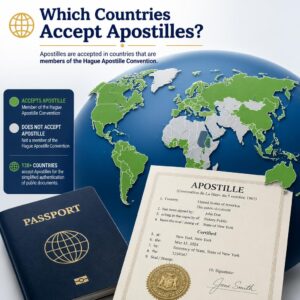
Which Countries Accept Apostilles?
Understanding Which Countries Recognise Spanish Documents Under the Hague Apostille Convention
One of the first questions families ask after learning about document authentication is:
It’s an important question because the answer determines the authentication process for your Spanish documents.
If your destination country accepts Apostilles under the Hague Apostille Convention, the process is generally quicker and more straightforward.
If it does not, Embassy Legalisation will usually be required instead.
This guide explains how the Hague Apostille Convention works, highlights some of the countries that commonly accept Apostilles and explains why it is always worth confirming the latest requirements before beginning the authentication process.
If you’re not yet familiar with the difference between an Apostille and Embassy Legalisation, we recommend reading Apostille vs Embassy Legalisation: What’s the Difference? first.
At a Glance
| Best for | Anyone checking whether a destination country accepts Apostilles. |
| Most Important Question | Which country will receive your documents? |
| If the Answer Is Yes | An Apostille will normally be sufficient. |
| If the Answer Is No | Embassy Legalisation will usually be required. |
| Can Funecon Help? | Yes. We can help confirm the appropriate authentication process before work begins. |
Why Do Countries Have Different Rules?
There is no single worldwide system for recognising official documents issued in another country.
Instead, countries decide how foreign documents should be authenticated before they will be accepted.
Many countries participate in the Hague Apostille Convention, allowing official documents to be recognised through an Apostille.
Others require Embassy Legalisation instead.
Neither system is “better” than the other.
They are simply different international agreements designed to achieve the same outcome:
Ensuring official documents can be trusted across borders.
What Is the Hague Apostille Convention?
The Hague Apostille Convention is an international agreement that simplifies the recognition of official public documents between participating countries.
Instead of completing multiple legalisation stages, member countries agree to recognise documents authenticated with an Apostille.
For families dealing with bereavement, probate or inheritance, this usually means a faster and simpler process.
However, membership can change over time, so it is always sensible to confirm the latest position before beginning.
Countries That Commonly Accept Apostilles
Many countries around the world recognise Apostilled Spanish documents.
Examples include:
Europe
- United Kingdom
- Ireland
- France
- Germany
- Italy
- Portugal
- Netherlands
- Belgium
North America
- United States
- Mexico
Oceania
- Australia
- New Zealand
South America
Many South American countries also participate in the Hague Apostille Convention, although requirements can vary depending on the authority receiving the documentation.
This is not intended to be a complete list.
Countries regularly join international agreements and individual administrative requirements can change.
For that reason, confirming the current position before beginning remains good practice.
Countries That May Require Embassy Legalisation
Some countries do not rely solely on the Apostille system.
Instead, they require Embassy Legalisation or additional authentication procedures.
Examples have traditionally included:
- Malaysia
- United Arab Emirates
- Qatar
Other countries may have their own specific procedures or bilateral agreements.
Because international arrangements continue to evolve, we always recommend confirming the latest requirements before obtaining documentation or arranging translations.
Why It’s Important to Check First
Knowing which authentication process applies affects far more than simply obtaining an Apostille or Embassy Legalisation.
It can influence:
- Which documents are required.
- Whether certified translations are needed.
- The order in which documents are prepared.
- Overall processing times.
- Estimated costs.
Taking a few minutes to confirm the destination country’s requirements at the beginning can often prevent weeks of unnecessary delays later.
Case Study – Two Different Countries, Two Different Processes
Recently we assisted two international families with Spanish documentation.
One family required documentation for use in the United Kingdom.
As the UK accepts Apostilles, the authentication process was relatively straightforward and completed within approximately one week.
Another family required documentation for Malaysia.
Although the documents originated in Spain, the receiving country’s requirements were entirely different.
Embassy Legalisation was required, together with certified translations and additional authentication before the paperwork could be accepted.
The documents were similar.
The destination country completely changed the process.
Will This List Change?
Yes.
International agreements evolve.
Countries occasionally join the Hague Apostille Convention or update their administrative procedures.
For this reason, we periodically review our guidance to help ensure the information remains accurate.
Where there is any uncertainty, we recommend confirming the latest requirements before beginning the authentication process.
Common Mistakes
The most common misunderstandings include:
- Assuming every country accepts Apostilles.
- Following advice based on another country’s procedures.
- Using outdated online information.
- Beginning translations before confirming the destination country’s requirements.
- Assuming every authority within a country asks for identical documentation.
Fortunately, these issues are usually easy to avoid with a little planning.
Frequently Asked Questions
Does every country accept Apostilles?
No.
Only countries participating in the Hague Apostille Convention generally recognise Apostilled documents.
How do I know whether my country accepts Apostilles?
The safest approach is to confirm the destination country’s current requirements before beginning the authentication process.
Can requirements change?
Yes.
International agreements and administrative procedures occasionally change, which is why we recommend checking the latest information whenever official documents are required.
Does accepting Apostilles mean translations are not required?
Not necessarily.
Translation requirements are separate from document authentication and depend on the receiving authority.
Can Funecon help confirm the correct process?
Yes.
We can help identify the appropriate authentication route and coordinate the required documentation from Spain.
Related Reading
Need to understand the difference between authentication methods?
Read:
Apostille vs Embassy Legalisation: What’s the Difference?
Already know you need an Apostille?
Read:
How to Apostille a Spanish Death Certificate
Need Embassy Legalisation instead?
Read:
Embassy Legalisation of Spanish Death Documents
Looking for the complete overview?
Return to:
How to Authenticate Spanish Documents for Use Abroad
Explore More
Looking for something else? Browse our complete collection of practical guides covering funeral planning, cremation, repatriation, legal documentation and post-death administration in Spain.
Need Help?
Knowing whether a country accepts Apostilles is often the first decision that shapes the rest of the authentication process.
Once you know which route applies, preparing the correct documents becomes much more straightforward.
If you’re arranging Spanish documentation for use overseas, we can help confirm the appropriate authentication process, coordinate the necessary paperwork and support you throughout each stage of the journey.
Have questions? Want us to visit your area for a Coffee Morning?
We’re here to help. Leave your details below if you’d like a no-obligation call, or if you’d like us to arrange a Coffee Morning in your town. Our goal is to bring clarity, peace of mind, and honest information to the expat community in Spain.