 Call
Call Here When You Need Us

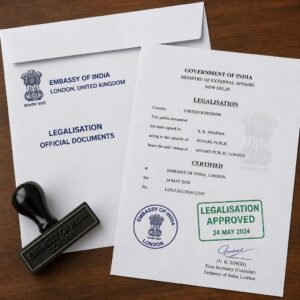
Embassy Legalisation of Spanish Death Documents
How to Prepare Spanish Death Documentation for Countries That Do Not Accept Apostilles
When a family discovers that an Apostille is not enough for their destination country, it can feel as though the process suddenly becomes much more complicated.
In reality, the objective remains exactly the same.
Your Spanish documents simply need to be authenticated through a different international process.
This process is known as Embassy Legalisation.
Although Embassy Legalisation usually involves additional stages and longer processing times than an Apostille, understanding the process early can help avoid unnecessary delays and ensure the documentation is accepted by the receiving authorities.
If you’re still unsure whether your destination country requires an Apostille or Embassy Legalisation, we recommend first reading Apostille vs Embassy Legalisation: What’s the Difference?
At a Glance
| Best for | Families needing Spanish death documents recognised in countries that do not accept Apostilles. |
| Typical Time | Usually between 4 and 10 weeks, although some countries may take longer. |
| Most Important Step | Confirm the destination country’s exact requirements before obtaining translations or arranging legalisation. |
| Common Documents | Death Certificates, Cremation Certificates, Probate Documents and other official Spanish documentation. |
| Can Funecon Help? | Yes. We can coordinate document collection, certified translations and Embassy Legalisation from Spain. |
What Is Embassy Legalisation?
Embassy Legalisation is an international authentication process used when the destination country does not recognise Apostilles or requires additional verification before accepting foreign official documents.
Rather than a single certification, Embassy Legalisation is often a sequence of official steps, each confirming the authenticity of the previous one.
Although this sounds complicated, most families only need to understand one thing:
The destination country decides the process—not Spain.
Every country has its own requirements, which is why confirming the correct procedure before beginning is so important.
Why Isn’t an Apostille Enough?
Many countries are members of the Hague Apostille Convention, allowing official documents to be recognised using an Apostille alone.
However, not every country participates in this system.
Where a country requires Embassy Legalisation, an Apostille on its own may not be accepted.
Instead, additional authentication is needed before the documents can be recognised overseas.
If your destination country accepts Apostilles, our guide How to Apostille a Spanish Death Certificate explains that process in more detail.
The Typical Embassy Legalisation Process
Although the exact requirements differ from one country to another, the process often follows a similar sequence.
Step 1 – Obtain the Correct Official Documents
Everything begins with obtaining the correct official Spanish documentation.
Depending on your circumstances, this may include:
- Literal Death Certificate
- Cremation Certificate
- Probate documentation
- Court documentation
- Other official civil registry documents
Obtaining the correct document at the beginning often prevents delays later in the process.
Step 2 – Confirm Translation Requirements
One of the biggest misconceptions is assuming that translation always comes either first or last.
In reality, the correct sequence depends on the destination country.
Some countries require:
- Certified translations.
- Sworn translations.
- Translation after legalisation.
- Translation before legalisation.
- Authentication of the translated document itself.
This is why confirming the country’s requirements before arranging translations is so important.
Step 3 – Authentication and Legalisation
Once the documentation has been prepared correctly, the required legalisation stages are completed.
Depending on the country, this may involve authentication by Spanish authorities followed by legalisation through the destination country’s embassy or consulate.
The exact authorities involved vary, but the objective remains the same:
To ensure the receiving country recognises the Spanish documents as genuine.
Step 4 – International Use
Once every required stage has been completed, the documents can normally be presented to the authority requesting them.
This may include:
- Government departments.
- Probate lawyers.
- Courts.
- Financial institutions.
- Insurance companies.
- Civil registry offices.
How Long Does Embassy Legalisation Take?
Unlike an Apostille, Embassy Legalisation generally involves several organisations working in sequence.
Typical processing time is:
Four to ten weeks
However, timing depends on factors such as:
- Embassy processing times.
- Translation requirements.
- Public holidays.
- Administrative procedures.
- Country-specific regulations.
Where important legal deadlines exist, allowing additional time is always advisable.
Case Study – Malaysia
One recent family required Spanish documentation for use in Malaysia.
Unlike countries that accept Apostilles, the documentation required Embassy Legalisation.
The process involved not only preparing the official Spanish documents but also ensuring that the certified translations met the receiving country’s requirements.
Importantly, the translations themselves also required legalisation before the documentation could be accepted.
Although this added several additional stages, careful planning at the beginning avoided unnecessary duplication and ensured the documents were ultimately accepted.
This experience reinforced an important lesson:
Every country should be treated as an individual process rather than assuming the same rules apply everywhere.
Common Mistakes
The majority of delays arise because families begin the process before understanding the destination country’s requirements.
Common examples include:
- Assuming every country accepts Apostilles.
- Arranging translations before confirming the legalisation sequence.
- Obtaining the wrong version of an official document.
- Underestimating the overall timeframe.
- Assuming advice for one country also applies to another.
Fortunately, these issues are usually avoidable with good planning.
Frequently Asked Questions
Why does Embassy Legalisation take longer than an Apostille?
Embassy Legalisation often involves several organisations rather than a single authentication process, resulting in longer processing times.
Does every non-Apostille country follow the same procedure?
No.
Each country establishes its own requirements for recognising foreign official documents.
Will I need certified translations?
Possibly.
Translation requirements depend entirely on the receiving country and the authority requesting the documents.
Can translated documents also require legalisation?
Yes.
Some countries require both the original documents and the certified translations to be authenticated before they will be accepted.
Can Funecon coordinate the process?
Yes.
We regularly assist international families by coordinating official documentation, certified translations and Embassy Legalisation, helping ensure every stage is completed in the correct order.
Related Reading
Unsure whether your country requires Embassy Legalisation?
Read:
Apostille vs Embassy Legalisation: What’s the Difference?
Need an Apostille instead?
Read:
How to Apostille a Spanish Death Certificate
Looking for country-specific guidance?
Read:
Which Countries Accept Apostilles?
Want the complete overview?
Return to:
How to Authenticate Spanish Documents for Use Abroad
Explore More
Looking for something else? Browse our complete collection of practical guides covering funeral planning, cremation, repatriation, legal documentation and post-death administration in Spain.
Need Help?
Embassy Legalisation can feel intimidating because every country has slightly different requirements.
In practice, success usually comes down to preparing the correct documents, following the correct sequence and allowing enough time for the process to be completed.
If you need Spanish death documentation recognised in a country that requires Embassy Legalisation, we can coordinate the process from Spain, helping you understand what is required, keeping you informed at every stage and working to minimise unnecessary delays during what is often already a difficult time.
Have questions? Want us to visit your area for a Coffee Morning?
We’re here to help. Leave your details below if you’d like a no-obligation call, or if you’d like us to arrange a Coffee Morning in your town. Our goal is to bring clarity, peace of mind, and honest information to the expat community in Spain.