 Call
Call Here When You Need Us
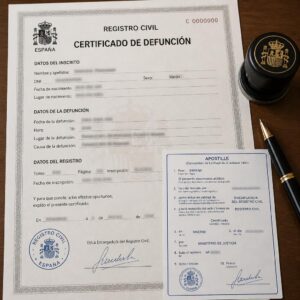
How to Apostille a Spanish Death Certificate
A Step-by-Step Guide to Preparing Spanish Death Documents for Use Abroad
When someone tells you that a Spanish death certificate needs an Apostille, the next question is almost always:
“How do I actually get one?”
Fortunately, if the country where the document will be used accepts Apostilles under the Hague Apostille Convention, the process is usually more straightforward than Embassy Legalisation.
However, obtaining an Apostille involves more than simply attaching a certificate to a document. You first need the correct version of the death certificate, and in some cases you may also need certified translations or additional documentation depending on how the document will be used overseas.
This guide explains the process step by step and highlights the most common mistakes that can delay international acceptance.
If you’re still unsure whether you need an Apostille or Embassy Legalisation, we recommend reading Apostille vs Embassy Legalisation: What’s the Difference? before continuing.
At a Glance
| Best for | Families needing a Spanish death certificate recognised in an Apostille country. |
| Typical Time | Around one week once the correct documents have been obtained. |
| Most Common Countries | United Kingdom, Ireland, France, Germany, Australia and many other Hague Convention countries. |
| Key Requirement | An official Spanish death certificate suitable for Apostille. |
| Can Funecon Help? | Yes. We can obtain the documentation, arrange the Apostille and coordinate the process on your behalf. |
What Is an Apostille?
An Apostille is an internationally recognised certificate that confirms an official Spanish document is genuine.
It allows that document to be accepted in another country that is also a member of the Hague Apostille Convention without requiring Embassy Legalisation.
For many international families, this is the quickest and simplest way of preparing Spanish documents for use abroad.
Which Death Certificate Will You Need?
One of the most common misunderstandings is assuming that any death certificate can be Apostilled.
In reality, the document must first be an official document issued by the appropriate Spanish authority.
Depending on the circumstances, this may include:
- Literal Death Certificate (Certificado Literal de Defunción)
- Multilingual Death Certificate (where appropriate)
- Other official documentation required for probate or estate administration
The correct document often depends on how it will be used in the destination country.
For this reason, we recommend confirming exactly what has been requested before obtaining an Apostille.
Step 1 – Confirm the Destination Country
Before requesting anything, identify where the documents will be used.
If the destination country accepts Apostilles, this guide applies.
If not, you will normally need Embassy Legalisation instead.
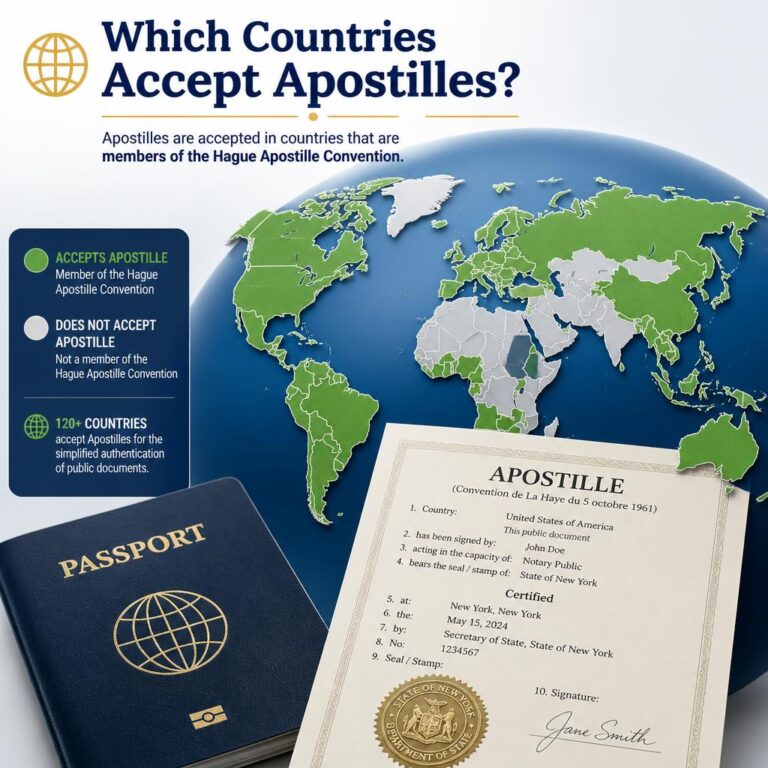
Our guide Which Countries Accept Apostilles? provides an overview of the most common destination countries.
Step 2 – Obtain the Correct Spanish Document
Once you know which document is required, obtain the official version issued by the relevant Spanish authority.
This is an important stage because requesting the wrong certificate can result in unnecessary delays and additional costs.
If you’re uncertain which document is appropriate, obtaining advice before ordering documentation is often worthwhile.
Step 3 – Check Whether a Translation Is Required
Not every country requires translations.
Some authorities accept multilingual documentation.
Others require certified translations.
The requirements depend entirely on the receiving authority.
It is generally better to confirm the translation requirements before arranging translations, as unnecessary translations increase both cost and processing time.
Step 4 – Obtain the Apostille
Once the correct documentation has been obtained, the Apostille can be issued by the competent authority in Spain.
The Apostille confirms the authenticity of the signature or seal appearing on the official document.
It does not verify the contents of the document itself.
Once completed, the document is normally ready for use in another Hague Convention country.
Step 5 – Send the Documentation Overseas
After the Apostille has been completed, the documents can normally be presented to the authority requesting them.
Depending on the circumstances this may include:
- Probate solicitors
- Government departments
- Courts
- Insurance companies
- Banks
- Registry offices
Always retain copies of the documentation before sending original documents overseas.
How Long Does It Take?
Although processing times vary, obtaining an Apostille is generally much quicker than Embassy Legalisation.
Typical timeframe:
Around one week
Factors that may influence timing include:
- Obtaining the original documents.
- Public holidays.
- Translation requirements.
- Courier delivery.
- Administrative processing times.
Where legal deadlines apply, it is advisable to begin the process as early as possible.
Case Study – United Kingdom
A family required a Spanish death certificate for probate proceedings in the United Kingdom.
Because the UK accepts Apostilles, Embassy Legalisation was not required.
After obtaining the correct death certificate, the Apostille process was completed and the documentation was accepted by the receiving authority without further authentication.
The overall process was completed considerably faster than would have been possible under Embassy Legalisation procedures.
Common Mistakes
The majority of delays occur before the Apostille is even requested.
Common issues include:
- Ordering the wrong version of the death certificate.
- Assuming translations are always required.
- Arranging translations before confirming the destination country’s requirements.
- Confusing an Apostille with Embassy Legalisation.
- Waiting until shortly before legal deadlines.
Most of these problems can be avoided through careful planning at the beginning of the process.
Frequently Asked Questions
Can I Apostille a photocopy of a death certificate?
Generally, the Apostille applies to official documentation issued by the appropriate authority. Requirements can vary depending on the document and its intended use.
Does every country accept Apostilles?
No.
Only countries participating in the Hague Apostille Convention generally accept Apostilled documents.
If the destination country is not a member, Embassy Legalisation is usually required instead.
Do I need a translation before obtaining an Apostille?
Not always.
The correct order depends on the destination country’s requirements.
Confirming the process before arranging translations can help avoid unnecessary expense.
How long is an Apostille valid?
The Apostille itself does not usually expire.
However, some organisations require recently issued documents, so it is sensible to confirm any time limits with the authority requesting the paperwork.
Can Funecon arrange this for me?
Yes.
We can assist with obtaining official Spanish documentation, coordinating Apostilles and advising on the most appropriate process based on the destination country.
Related Reading
Unsure whether you need an Apostille?
Read:
Apostille vs Embassy Legalisation: What’s the Difference?
Destination country doesn’t accept Apostilles?
Read:
Embassy Legalisation of Spanish Death Documents
Looking for your country’s requirements?
Read:
Which Countries Accept Apostilles?
Need the complete overview?
Return to:
How to Authenticate Spanish Documents for Use Abroad
Explore More
Looking for something else? Browse our complete collection of practical guides covering funeral planning, cremation, repatriation, legal documentation and post-death administration in Spain.
Need Help?
Obtaining an Apostille is often straightforward once you have the correct documentation. The challenge is making sure the right document is prepared in the right order for the country where it will be used.
If you’re dealing with a death in Spain and need official documentation recognised overseas, we can coordinate the process from obtaining the documentation through to international authentication, helping you avoid unnecessary delays and giving you confidence that the paperwork has been prepared correctly.
Have questions? Want us to visit your area for a Coffee Morning?
We’re here to help. Leave your details below if you’d like a no-obligation call, or if you’d like us to arrange a Coffee Morning in your town. Our goal is to bring clarity, peace of mind, and honest information to the expat community in Spain.