 Call
Call Here When You Need Us

Apostille vs Embassy Legalisation: What’s the Difference?
Understand Which Authentication Process Your Spanish Documents Need
One of the most common questions families ask us is:
“I’ve been told my Spanish documents need to be legalised. What does that actually mean?”
The answer depends entirely on which country will receive the documents.
Some countries accept an Apostille, making the process relatively straightforward. Others require Embassy Legalisation, which usually involves additional stages and longer processing times.
Understanding which process applies before you begin can save considerable time, reduce unnecessary costs and help avoid delays when important documents are needed overseas.
This guide explains the differences between Apostilles and Embassy Legalisation, when each is required and how to determine which process applies to your situation.
If you’re looking for a broader overview of international document authentication, we recommend reading our cornerstone guide:
How to Authenticate Spanish Documents for Use Abroad: Apostilles, Embassy Legalisation and International Requirements Explained.
At a Glance
| Best for | Anyone unsure whether they need an Apostille or Embassy Legalisation. |
| Typical Decision Time | Usually just a few minutes once you know the destination country. |
| Most Important Factor | The country where the documents will be used. |
| Common Documents | Death Certificates, Cremation Certificates, Birth Certificates, Marriage Certificates, Probate Documents and Powers of Attorney. |
| Can Funecon Help? | Yes. We can advise which authentication process is appropriate and coordinate the required documentation from Spain. |
The Difference in One Sentence
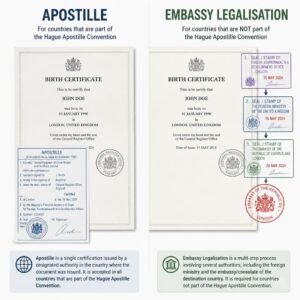
Although both processes authenticate official documents for international use, they are not interchangeable.
- An Apostille is used for countries that are members of the Hague Apostille Convention.
- Embassy Legalisation is required for countries that do not recognise Apostilles or have additional authentication requirements.
The purpose is exactly the same.
The process is different.
What Is an Apostille?
An Apostille is an internationally recognised certificate issued by the competent authority in the country where the original document was produced.
It confirms that the signature, seal or stamp on the document is genuine, allowing it to be accepted in another member country of the Hague Apostille Convention without further embassy authentication.
For families dealing with Spanish documents, this often provides the quickest and simplest route to international recognition.
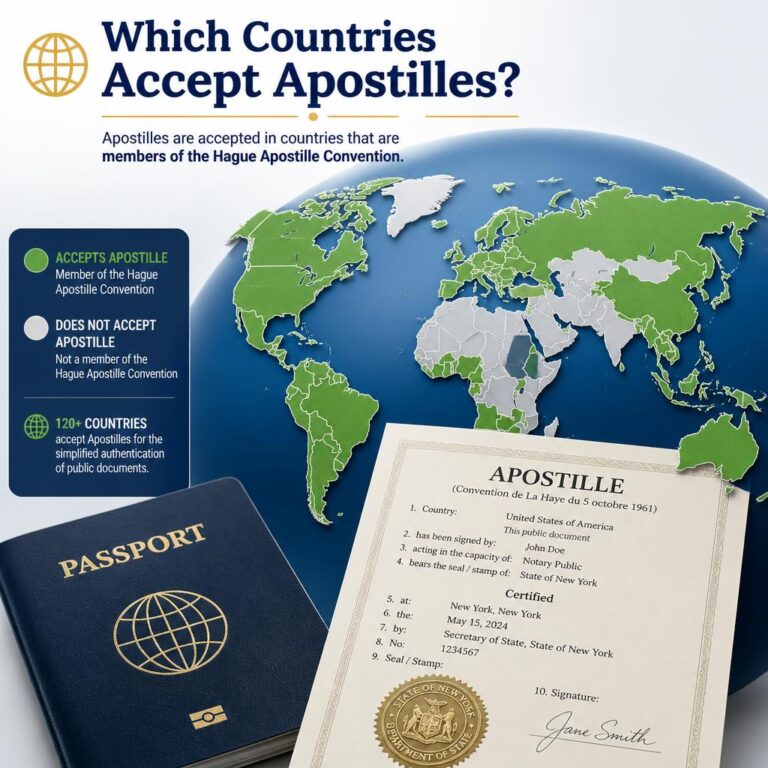
Countries such as the United Kingdom, Ireland, France, Germany and Australia generally recognise Apostilled Spanish documents.
If your destination country accepts Apostilles, you will normally not need Embassy Legalisation.
What Is Embassy Legalisation?
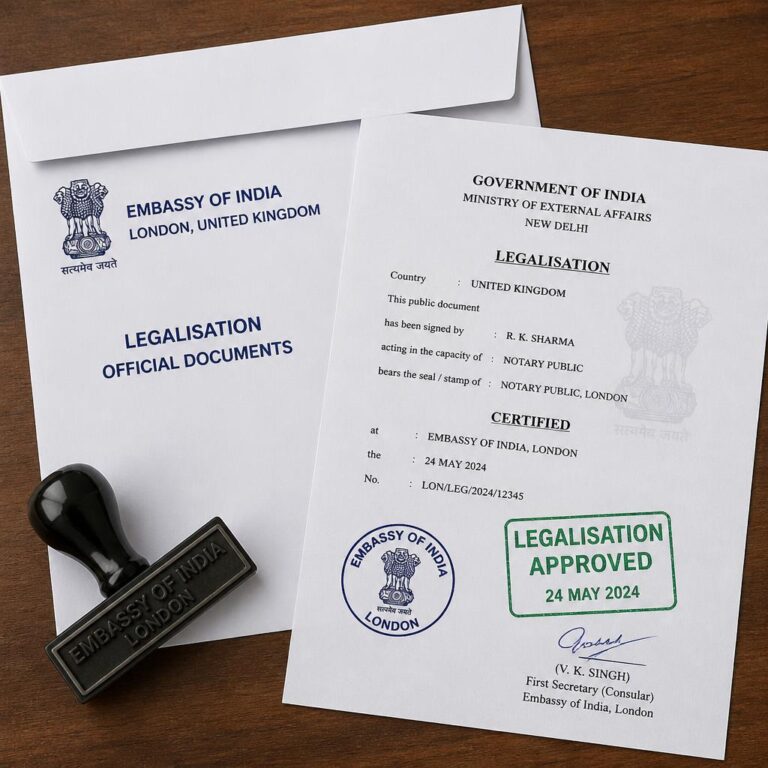
Embassy Legalisation is a more extensive authentication process used for countries that do not accept Apostilles or require additional verification.
Although the exact procedure varies, it commonly involves several stages, including:
- Authentication by the relevant Spanish authorities.
- Official sworn translations where required.
- Legalisation by the destination country’s embassy or consulate.
- Additional country-specific verification if applicable.
Because several organisations may become involved, Embassy Legalisation usually takes significantly longer than obtaining an Apostille.
Countries such as Malaysia, the United Arab Emirates and Qatar have traditionally required this type of process, although international agreements can change over time.
For this reason, we always recommend confirming the current requirements before beginning.
Which Process Do You Need?
Fortunately, deciding which process applies is usually straightforward.
Ask yourself one question:
Which country will receive the documents?
If the country is a member of the Hague Apostille Convention, an Apostille will normally be sufficient.
If it is not, Embassy Legalisation is usually required.
The destination country—not the type of document—is what determines the authentication route.
If you’re unsure whether your country accepts Apostilles, our companion guide Which Countries Accept Apostilles? provides an overview of the most common destinations.
Typical Timeframes
Although every case is different, the difference in processing times is often significant.
| Process | Typical Time |
|---|---|
| Apostille | Around one week |
| Embassy Legalisation | Typically four to ten weeks |
Additional requirements such as certified translations, embassy appointments or country-specific procedures can extend these timeframes.
If documents are required for probate, inheritance, property sales or other legal deadlines, it is advisable to begin the process as early as possible.
Common Situations
Families often require document authentication for reasons such as:
- Registering a death overseas.
- Probate and estate administration.
- Inheritance procedures.
- Property transactions.
- Immigration or residency applications.
- Marriage registration.
- Birth registration.
- Powers of Attorney.
The required authentication process remains the same regardless of the reason.
What changes are the documents involved and the destination country.
Case Study – United Kingdom
A family recently needed Spanish death documentation to be recognised in the United Kingdom.
As the UK accepts Apostilles, the documents were authenticated using the Apostille process.
The paperwork was completed relatively quickly, allowing the family to continue administering the estate without additional embassy procedures.
Case Study – Malaysia
In another case, Spanish documentation needed to be recognised in Malaysia.
This required Embassy Legalisation rather than an Apostille.
In addition, the official translations also required legalisation before the documents could be accepted by the receiving authorities.
Although the process involved more stages, careful planning helped avoid unnecessary delays.
This illustrates why it is important not to assume that every country follows the same authentication process.
Common Mistakes
The most common problems we encounter include:
- Assuming every country accepts Apostilles.
- Starting official translations before confirming the required authentication process.
- Using unofficial translations where certified translations are required.
- Leaving insufficient time before legal deadlines.
- Following advice based on another country’s requirements.
Every destination country has its own rules, and confirming these at the beginning can prevent significant delays later.
Frequently Asked Questions
Is an Apostille the same as Embassy Legalisation?
No. Both authenticate official documents for international use, but they apply to different groups of countries.
Which process is faster?
In most cases, obtaining an Apostille is considerably quicker than completing Embassy Legalisation.
Does the type of document determine which process I need?
Usually not.
The deciding factor is almost always the country where the document will be used.
Can translations also require legalisation?
Yes.
Some countries require not only the original document to be authenticated but also the certified translation.
This is one reason why confirming the destination country’s requirements before beginning is so important.
Can Funecon arrange the entire process?
Yes.
Where appropriate, we can coordinate document collection, certified translations, Apostilles and Embassy Legalisation, helping families manage the process from Spain through to international acceptance.
Related Reading
If you already know an Apostille is required, continue with:
How to Apostille a Spanish Death Certificate
If your destination country requires Embassy Legalisation, read:
Embassy Legalisation of Spanish Death Documents
Looking for country-specific guidance?
Which Countries Accept Apostilles?
For a complete overview of international document authentication, return to:
How to Authenticate Spanish Documents for Use Abroad
Explore More
Looking for something else? Browse our complete collection of practical guides covering funeral planning, cremation, repatriation, legal documentation and post-death administration in Spain.
Need Help?
Understanding the difference between an Apostille and Embassy Legalisation is the first step. Completing the process correctly is the next.
If you’re dealing with bereavement, probate, inheritance or another international legal matter, we can help coordinate the documentation required for use outside Spain, working with trusted professionals and keeping you informed throughout the process.
Have questions? Want us to visit your area for a Coffee Morning?
We’re here to help. Leave your details below if you’d like a no-obligation call, or if you’d like us to arrange a Coffee Morning in your town. Our goal is to bring clarity, peace of mind, and honest information to the expat community in Spain.